Manhattan in the dark

Over the last five days, Sandy and her effects has filled my media, while I’ve sat safely in my Bed-Stuy apartment. I’ve not lost a minute of power or internet access, the stores around me have plenty of food and drink, and all of my outdoor plants survived the downpour without a fuss. In contrast to the havoc and destruction of shoreline within 10 km of my home, the hurricane’s most direct effect on my life has been the cancellation of the classes and meetings which drag me to Manhattan three days a week. This detachment from the drama is probably what prompted me to get out of bed at 1am, hop on my bike, and peddle to the Manhattan bridge. 

Making my way to the bridge, Brooklyn was quieter than some Thursday nights, though the cold could explain that as well as this week’s events. Half way across the bridge, the street lamp light ended. Looking at the city ahead, some buildings to the North were illuminated, such as the Empire State (like a boss, according to someone’s tweet) but the highways were sparsely lit, leaving most cars to work with their headlights. The first rows of high-rises off the Hudson shimmered from the cabs and other working vehicles zipping by; it took me a moment to realise they were not lit from within. On the bike path, my little front light did little more than warn oncoming traffic (yes there were other cyclists out at 1:30) and a slowed my descent to a creep going through the covered corners at the bridge exit. 

Under normal circumstances, I don’t like Manhattan. While it is filled with wonderful things, the omnipresent hype and hurry impose an ennerving whine and jangle to any time spent in the borough, not matter the time or place. There is no quiet, no space to be alone, no chance to get away from the lives of others. I go to Manhattan when the promised charms outweigh the dreaded stress or when it is really necessary, and leave fairly quickly when my tolerance is exceeded. Late Thursday night traffic jams on Bowery are usually miserable with glarring headlights, frsutrated honking, vehicles idling in the bike lane, and cab-hungry pedestrians popping out between parked cars without eyes or ears for the two wheeled.

In contrast to the usual distress, riding through Manhattan in the dark was pleasant rather than spooky, for all that it looked like the beginning of the enviro-apocalypse. A couple of big intersections had generator supported lighting, some others were marked by hissing flares, and many had nothing to help travelers without massive headlights. Without traffic lights, the cabs and trucks were polite for once, cautious around the smaller road users, all watched by many police cars (ratio around 1 out of 10 vehicles on the road, while I was riding).

On those stretches of blocks without other vehicles around, my eyes managed to navigate the bumpy streets from the glow reflected down from the clouds. Every intersection brought sounds of distant activity, city life reduced to the essentials, in hibernation rather than dead. To prove it, the few pedestrians crossed roads with their usual brashness, armed with flashlights to blind anyone who might challenge with their choice of crosswalk. 

I rode my usual route to NYU, to see which buildings had been given generators. To my surprise, my building was powered up and the card reader security system even let me in. Going around Washington Square park, there was still a lot of fallen branches; rats could be heard squeaking around them when they noticed my passing. 

I’d heard that power had been connected higher up, so I rode University and 6th Ave Northward. Around Penn Station, the streets were lit. With the number of cabs, food vendors, and people out up there, it looked like 3 am on a Tuesday. Turning around at Central Park, there were birds chirping in their typical city induced confusion around the hotel lights. But not all was normal between 40th and 58th; the Hilton looked to be running on a generator, some side streets were blockaded, sometimes with police on guard, and many buildings were all dark above the ground floor store fronts. 

The last time I rode down 5th avenue through midtown was at rush hour last December; it has been filled with impatient cars and drivers well practiced in traffic jam etiquette/survival, inclined to push me into the lane the buses had been trying to push me out of. This time, it was somewhat more calm; garbage trucks barreled along but nobody minded my un-cyclist habit of respecting traffic lights at unfamiliar intersections. 

To return to home, I hit Broadway on my way to the Brooklyn bridge. Below Houston, it was nearly deserted, only a few food vendors, some vans, and the inescapable cop cars with their night-sight ruining flashing lights. Turning left off of Broadway from the right hand lane has never been so easy. There had been reports of city hall and wallstreet being powered up, so I was curious to see how many had use of these emergency supplies. While a few places again had ground level lighting in buildings, and a couple of sky scrappers looked to be upen for regular business at 2-3 am, city hall was not illuminated as it had been for halloween and the courts were dark. 

From Brooklyn bridge, it was again clear that some buildings had generators, but most of the area was in the dark. Crossing over, there was a point at which the overhead lighting turned on and I was back to normal late night riding conditions. On my way home, I took some detours to look over the Hudson, trying to remember how the skyline had looked previously. The distributions of lights had to do with power and money, but on this fourth night without electricity, much of Manhattan was patiently waiting for this awkward interruption to end. Unlike those who lost homes, livelyhoods, and family members, this city has hope that life can go back to how it was before Sandy, once the infrastructure has healed. 

Amid the many loses, these large scale calamities can also do a lot of good for the people who survive them, brining community, kindness and fresh perspective on daily life. From my home patch of safety, I’m outside of the reach of most of those benefits. But at least by riding out tonight, I’ve experienced quiet in the middle of a great city, and that serenity will make it a little easier to stand in those same places when the usual hustle and bustle returns.
Studying myself

How else does a grad student get 40+ hours of experimentation time over 20 sessions from one human subject?

I thought someone might have an issue with my idea of using myself, but apparently not. The NYU ethics review office didn’t even want to hear about what responses I’d be recording, or what protocols I’d be following. Maybe they assumed that music is a harmless stimulus, or that I knew I wasn’t allergic to the glue we use to attached electrodes, or that I was very unlikely to sue the school because of research I’d planed myself. I hope they didn’t care because the data collection is happening at another institution, in collaboration with someone who’s standing ethics certificate does cover this type of experiment.

Since no one has tried to stop me, I am now over half way through collecting what should be a very interesting continuous response data set. I’m collecting felt emotion ratings (Valence X Arousal) with an optional third rating scale to report whether I was experiencing emotion from the perspective of a listener or a performer, or in between. I say optional because in practice, I haven’t consistently remembered to evaluate this as well as keep up with the emotion stuff. The physiological data being collected is skin conductance, temperature, blood volume pulse, chest expansion (respiration), and sEMG of the zygomaticus (cheek), the corrugator (eyebrow), and the trapezoid (back of the neck). These signals include information related to emotional arousal and valence, though the how and why can be a bit indirect.

The stimuli are fairly divers as well. Once the recordings are finished, I’ll go through each piece to discuss why it was chosen and how these responses related to what is in the music. But until then, here is the quick list of pieces (track, artist, album), in no particular order:

1. Varúð, Sigur Rós, Valtari
2. Bizness, Tune-Yards, Whokill
3. Visiting Hours, Shane Koyczan, Visiting Hours (spoken word)
4. The Littlest Birds, The Be Good Tanyas, Blue Horse
5. Wavin’ Flag, Young Artists For Haiti, Wavin’ Flag
6. Basket, Dan Mangan, Nice, Nice, Very Nice
7. Movimento Preciso e Meccanico from Chamber Concerto (Ligeti), Alarm Will Sound, a/rhythmia
8. Feel Good Inc., Gorillaz, Demon Days
9. Gong Hotel, Radio Radio, Havre de Grâce
10. String Quartet No. 14 in C-Sharp Minor, Op. 131: II. Allegro molto Vivace et III. Andante moderato, Artemis Quartet, Beethoven: String Quartets, Op. 131, Op. 18-2, Op. 132, Op. 59-3
11. Something to Write Home About, I Am Robot And Proud, Uphill City
12. Dutch, Dessa, A Badly Broken Code
13. Stampede, The Quantic Soul Orchestra, Stampede
14. Sinnerman, Nina Simone, The Definitive Rarities Collection – 50 Classic Cuts
15. The Stand, Mother Mother, Eureka
16. Invention No. 2 in C minor BWV 773, Glenn Gould, Bach: Two and Three Part Inventions and Sinfonias, BWV 772-801
17. 1685/Bach, Nosaj Thing, Drift
18. Thieving Boy, Cleo Laine, Wordsongs
19. Fortuna Imperatrix Mundi: O Fortuna, OSM, Orff: Carmina Burana
20. Lousy Reputation, We Are Scientists, With Love And Squalor
21. Boum!, Charles Trenet, Paris After Dark
22. Le Rosier De Trois Couleurs De Roses, STRADA, Gadje
23. Romance (Debussy), Rachel Talitman and Luc Loubry, The Golden Age of Harp and French bassoon
24. Ne m’oubliez mie/DOMINO (Mo 236), Anonymous 4, Love’s Illusion
25. Portal, Origin, Informis, Infinitas, Inhumanitas

This totals to nearly an hour and a half of music. During each sessions, I take notes between pieces, which adds some time as well. Some are just to warn of sneezes or yawns which affect the physiological data, others mark changes in how I am interpreting the piece and reflections on what I think triggers my responses of one type or another.

The ethics issue is one I am still worrying about because I would like to release this data for other researchers to use. We need more public data sets for evaluating new ways of extracting relevant information from these continuous response series, and to help the discussion on what is and isn’t captured by these measures. In the interest of science, sharing is good. But this data set will necessarily be full of problems, not the least of which being that it comes from me, a member of the research community. I am going to discuss this data processionally, and I can’t honestly refer to the subject as anonymous, or FU. As someone with many ideas and opinions about emotion and continuous responses and music, I am not a naive participant; this data cannot be treated as that of the “average listener”. Nor do I expect people will be all that comfortable digging into a particular person’s emotional experiences. There must be discussions the problems of self study in psychology research, perhaps I can find some ideas for sharing strategies from that literature.

Sometimes, it’s just pretty

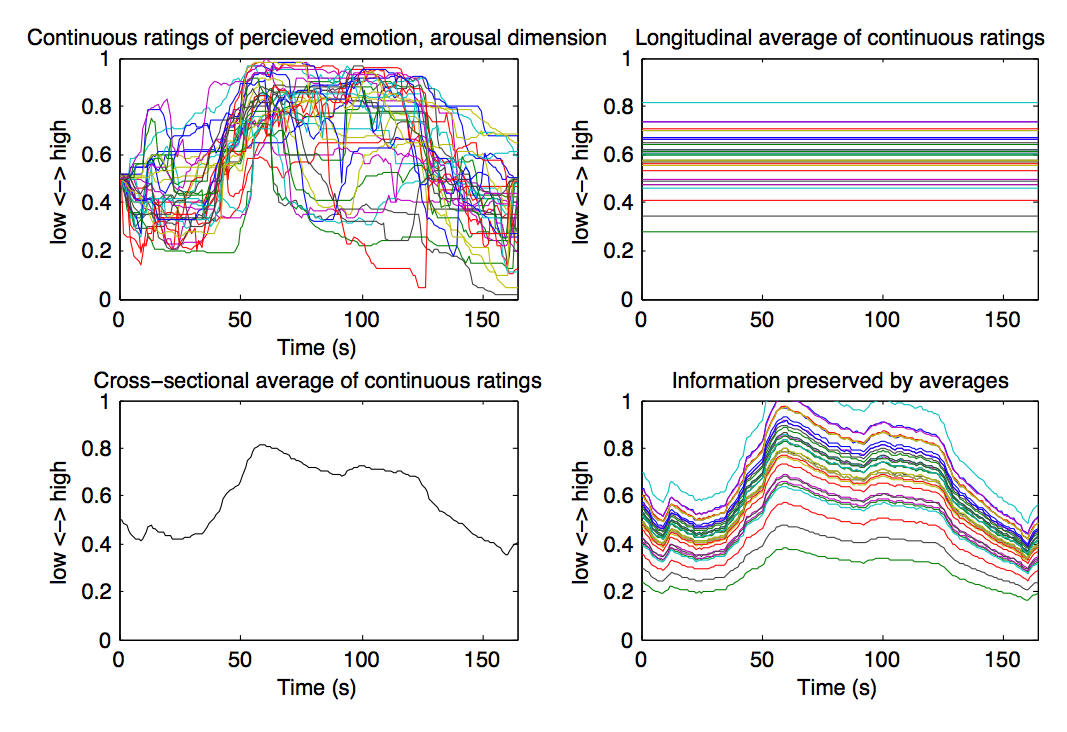
I’m working (yet again) on writing up Activity Analysis for publication. One of the issues I keep wavering on is how to discuss the relative merits of the averaging these messy collection of time series. Though part of me wants to howl from the roof tops every time I see the average time series published without apologies or qualifications, I do agree with the basic intuition that this summary can be meaningful. In looking for ways of illustrating my point, I made this graph:

The top right corner is a real collection of continuous responses, 35 ratings of perceived emotional arousal to the Adagio movement of J. Rodrigo’s Concierto de Aranjuez (from Mark Krohonen’s public data set.) Beside it is the average value for each response over time. Below it is the average rating time series, evaluated at each time point. And in the last corner is the reconstruction of the data set from these two reductions–a collection of time series which is equivalent to the original according to the summary stats used. Comparing the top left corner to the bottom right, there are obviously differences, differences that either dimensional reduction treat as noise. However, it does nothing to show something interesting about that presumed noise, so I don’t think it is worth space in this paper. Still, the stratification is pretty, and a nice little reminder of what goes missing in these calculations.

Sound, Sight and the other stuff

This morning, I’ve begin pocking at Audio-vision by Michel Chion, or rather parts of the english translation as made available by Google (thanks!) Already, in the forward by Walter Murch, I am faced with frustrating assumptions about how sight and sound relate and function in human perception. There is a lasting bad habit of treating the visual image as equivalent to the “real thing”, as the source, the event, rather than the trace of these. Here, like in many other discussions of the audio-visual, Murch shows an awareness of the perceptual particularities of sight in one breath, but then forgets the differences between image as seen, image as recorded, and the source in the next paragraph.

“For as far back in human history as you would care to go, sounds had seemed to be the inevitable and ‘accidental’ (and therefore mostly ignored) accompaniment of the visual–stuck like a shadow to the object that caused them.”

He is describing the nature of sound before the advent of audio recording technology, for which the idea of the shadow being lifted off of the object is appropriate. However, he appears to be guilty confusing the object with the sight of the object. More evidence of this shortsighted mistake:

“And here is the problem: the shadow that had heretofore either been ignored or consigned to follow along submissively behind the image was suddenly running free, or attaching itself mischievously to the  unlikeliest of things.”

The sound has never been shadow to the sight, though we do expect to be able to reconcile the timing of what we see with that of what we hear: when things match up we can safely infer the causal source of both, when they do not match we are in the more difficult spot of trying  to explain away the difference or imagining independent sources from less information.

There is much made of the many ways we can trick the ear into hearing a different source than what was real: watermelons, cornstarch, and old leather jackets have made many sound effects from which we are quick to infer very different sources. This should be read as a tribute to our imaginations rather than a sign that sound is dependent on image. After all, these are tricks first developed for radio, from whence listeners were following the stories told in mixtures of narration and acting. And even when there are accompanying images, our eyes do not always succeed in overruling our ears. Multi-modal perception studies have found that the dominance of visual perception is context specific and dependent on the quality of the information provided by each perceptual mode.

I have many more chapters to read here, so this objection is not one I can yet put to Michel Chion directly, but already I am wary of the idea that we hear/see film. It seems more useful to bypass the false binary and consider instead how we imagine the sources of action behind the combined sight and sound that film provides.

At the end of the introduction, he raised the question: “Why does King Sight still sit on his throne?” Like other targeted authority structures, it looks like the language (and the understanding these words represent) of the resistance is counter productive as it reinforces the existing hierarchy instead of questioning more carefully the origin of “King Sight”‘s power.

Learning Disability: Check

It’s official: I am learning disabled. OK, OK, that is a horrible way of describing it; please forgive me as I am new to being on this side of the able-ist discussion.

I got the results of my second set of diagnostic tests yesterday, and my mind is buzzing all over in attempt to sort out what this means for my present, future, and past. It feels like coming out all over again: raking through my history to reinterpret events in relation to this new self-awareness, seeing “the signs” in everyone around me, and trying to figure out how to change my way of acting and thinking to make this new identity fit. It will be a few weeks before my head is clear of this issue.

Learning disabilities are usual diagnosed through a measured discrepancy between a person’s cognitive abilities and their performance on specific language related tasks such as reading, writing, speaking, listening, as well as basic arithmetic. Their design is meant to measure memory and attention within these domains. All of the tasks are evaluated comparatively: given your age and level of education, how do you rank against your peers, and is this rank different from that of your measured intelligence?

By this definition, I fit the bill, however it fits in such a way that I feel awkward about waving it around. While the first set of tests (taken in Canada at the Canadian Centre for Dyslexia) identified dyslexic behaviours, the second set of tests (taken in NYC with a clinical neuropsychologist) gave evidence of the discrepancy by which I can be labeled and provided with services. It turns out (surprise surprise) that I am at the rather bright end of the cognitive scale, however my performance on these tests range from “very superior” to “average”, and “average” is lower than normal for someone with my perceptual reasoning capacities.

Looking back, this discrepancy makes a fair bit of sense. In elementary school, my teachers didn’t take much notice of me until grade 6. My grades were OK, and sometimes good, so no one had reason to worry. I remember feeling so frustrated at meeting people who had been labeled as gifted: they didn’t sound any more intelligent that I was, but other people had given them more fun things to do. At the same time, I’ve seen a lot of people suffer under that pressure to excel; I was probably saved a lot of heartache by just doing my thing and having my apparent abilities balance out the disabilities without a fuss. At higher levels of education, however, it has become more difficulty to hide the issue, and this diagnosis means reinterpreting the feelings of academic inadequacy of times past.

I still need to figure out the morality of using resources intended to help people with marked disadvantages to manage in a system that expects everyone to be normal. From the perspective of wanting to be evaluated fairly on what I know and understand, it makes sense to ask for help to represent myself appropriately. Similarly, there are likely tricks and skills I can develop to help get around whatever visual attention problems seem to be interfering with my processing of written language. But if I am in some ways already ahead of the game, how is it fair to ask for accommodations?

The point of taking these assessments was to get a sense of what might help me do better and be less frustrated in school, and I think they will help. There are many useful services to which I will have access through the Moses Centre (NYU’s centre for students with disabilities). Here is hoping I convince myself to take advantage of these opportunities now that they are being offered to me.