Advantages of experimenting on yourself

In the coming months, I’ll be taking results from the solo response project to several conferences, and reviewer feedback has me worried about people dismissing this data because I collected the data from myself. I keep getting distracted by these imaginary confrontations with suspicious researchers so it’s time I lay down some concisely-expressed arguments to appease the hypothetical skeptics.

Problem 1: One subject = bad empirical research

I don’t like this one because the premise is wrong, but I’ve gotten it a lot already, so here goes.    Continue reading “Advantages of experimenting on yourself”

Solo Response recording set up

Before I forget everything, let me get down the setup details of the experiment I ran last summer (2012). Besides selecting the 25 pieces and working out where I was going to run the experiment, there was a lot of other relevant details. The following descriptions are for the purpose of documenting the experiment’s methodology; I hope anyone interested in employing these methods will seek higher authorities for instructions of best practices.

Experiment setup
Stephen McAdams was kind enough to let me borrow some CIRMMT equipment (Thought Technologies’ ProComp Infiniti and a pile of sensors) and occupy some of his lab space for a month. Though a little casual by some standards, I made myself a cubical out of spare sound absorption panels in a large room that was usually unoccupied while I was recording. To get data from the ProComp in a useful format, Bennet Smith helped sort out some of his old scripts that conveniently time stamped the physiological sensor data and packaged it as UDP messages. That left me with getting some system set up run the experiment, provide a behavioural response interface, and save the recorded responses in a reliable fashion.   Continue reading “Solo Response recording set up”

Variables of Valence

While I am hoping to soon start blogging about responses to each stimulus used in the solo response project, it will take a bit longer to get all the signals tidied and a format of analysis set.  In the interim, here is a simple version of the mini talk I presented at the most recent NEMCOG meeting with links to audio for each example.

******

Variability of Emotional Valence: Inconsistencies in self-report continuous emotion ratings – Finn Upham, New York University

Listeners often report feeling emotions in response to music, whether happy or sad. Empirical work on continuous reports of felt emotion are however often challenged by substantial variation in emotional dynamics reported by different participants. Variability in responses is supposed to be caused in part by differences in individual listeners’ musical expertise, sensitivity and cultural background. Working with multiple responses from a single human subject should then make it easier to explore which other factors contribute to the variation in felt emotions reported during music listening.

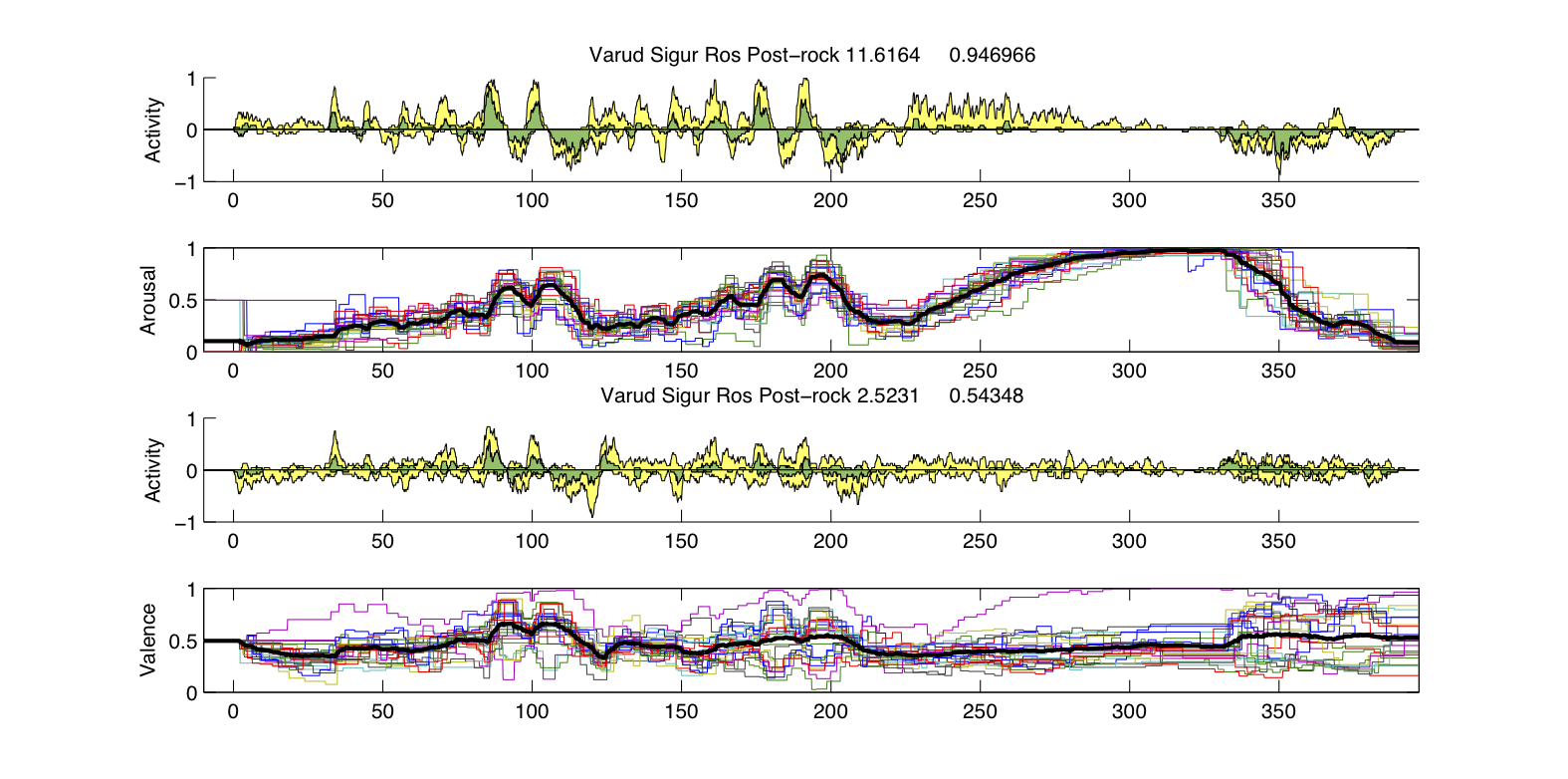
This summer, I collect continuous responses from myself (see the solo response project post). The analysis to follow uses the two dimensional felt emotion ratings (Arousal X Valence) as well as information from notes collected during the listening sessions.

Felt emotion from 24 listenings
Summary of felt emotion ratings from 24 listenings to Varud by Sigur Ros. Arousal and Valence ratings under rating change activity analysis and average rating time series.

Continue reading “Variables of Valence”

Manhattan in the dark

Over the last five days, Sandy and her effects has filled my media, while I’ve sat safely in my Bed-Stuy apartment. I’ve not lost a minute of power or internet access, the stores around me have plenty of food and drink, and all of my outdoor plants survived the downpour without a fuss. In contrast to the havoc and destruction of shoreline within 10 km of my home, the hurricane’s most direct effect on my life has been the cancellation of the classes and meetings which drag me to Manhattan three days a week. This detachment from the drama is probably what prompted me to get out of bed at 1am, hop on my bike, and peddle to the Manhattan bridge. 

Making my way to the bridge, Brooklyn was quieter than some Thursday nights, though the cold could explain that as well as this week’s events. Half way across the bridge, the street lamp light ended. Looking at the city ahead, some buildings to the North were illuminated, such as the Empire State (like a boss, according to someone’s tweet) but the highways were sparsely lit, leaving most cars to work with their headlights. The first rows of high-rises off the Hudson shimmered from the cabs and other working vehicles zipping by; it took me a moment to realise they were not lit from within. On the bike path, my little front light did little more than warn oncoming traffic (yes there were other cyclists out at 1:30) and a slowed my descent to a creep going through the covered corners at the bridge exit. 

Under normal circumstances, I don’t like Manhattan. While it is filled with wonderful things, the omnipresent hype and hurry impose an ennerving whine and jangle to any time spent in the borough, not matter the time or place. There is no quiet, no space to be alone, no chance to get away from the lives of others. I go to Manhattan when the promised charms outweigh the dreaded stress or when it is really necessary, and leave fairly quickly when my tolerance is exceeded. Late Thursday night traffic jams on Bowery are usually miserable with glarring headlights, frsutrated honking, vehicles idling in the bike lane, and cab-hungry pedestrians popping out between parked cars without eyes or ears for the two wheeled.

In contrast to the usual distress, riding through Manhattan in the dark was pleasant rather than spooky, for all that it looked like the beginning of the enviro-apocalypse. A couple of big intersections had generator supported lighting, some others were marked by hissing flares, and many had nothing to help travelers without massive headlights. Without traffic lights, the cabs and trucks were polite for once, cautious around the smaller road users, all watched by many police cars (ratio around 1 out of 10 vehicles on the road, while I was riding).

On those stretches of blocks without other vehicles around, my eyes managed to navigate the bumpy streets from the glow reflected down from the clouds. Every intersection brought sounds of distant activity, city life reduced to the essentials, in hibernation rather than dead. To prove it, the few pedestrians crossed roads with their usual brashness, armed with flashlights to blind anyone who might challenge with their choice of crosswalk. 

I rode my usual route to NYU, to see which buildings had been given generators. To my surprise, my building was powered up and the card reader security system even let me in. Going around Washington Square park, there was still a lot of fallen branches; rats could be heard squeaking around them when they noticed my passing. 

I’d heard that power had been connected higher up, so I rode University and 6th Ave Northward. Around Penn Station, the streets were lit. With the number of cabs, food vendors, and people out up there, it looked like 3 am on a Tuesday. Turning around at Central Park, there were birds chirping in their typical city induced confusion around the hotel lights. But not all was normal between 40th and 58th; the Hilton looked to be running on a generator, some side streets were blockaded, sometimes with police on guard, and many buildings were all dark above the ground floor store fronts. 

The last time I rode down 5th avenue through midtown was at rush hour last December; it has been filled with impatient cars and drivers well practiced in traffic jam etiquette/survival, inclined to push me into the lane the buses had been trying to push me out of. This time, it was somewhat more calm; garbage trucks barreled along but nobody minded my un-cyclist habit of respecting traffic lights at unfamiliar intersections. 

To return to home, I hit Broadway on my way to the Brooklyn bridge. Below Houston, it was nearly deserted, only a few food vendors, some vans, and the inescapable cop cars with their night-sight ruining flashing lights. Turning left off of Broadway from the right hand lane has never been so easy. There had been reports of city hall and wallstreet being powered up, so I was curious to see how many had use of these emergency supplies. While a few places again had ground level lighting in buildings, and a couple of sky scrappers looked to be upen for regular business at 2-3 am, city hall was not illuminated as it had been for halloween and the courts were dark. 

From Brooklyn bridge, it was again clear that some buildings had generators, but most of the area was in the dark. Crossing over, there was a point at which the overhead lighting turned on and I was back to normal late night riding conditions. On my way home, I took some detours to look over the Hudson, trying to remember how the skyline had looked previously. The distributions of lights had to do with power and money, but on this fourth night without electricity, much of Manhattan was patiently waiting for this awkward interruption to end. Unlike those who lost homes, livelyhoods, and family members, this city has hope that life can go back to how it was before Sandy, once the infrastructure has healed. 

Amid the many loses, these large scale calamities can also do a lot of good for the people who survive them, brining community, kindness and fresh perspective on daily life. From my home patch of safety, I’m outside of the reach of most of those benefits. But at least by riding out tonight, I’ve experienced quiet in the middle of a great city, and that serenity will make it a little easier to stand in those same places when the usual hustle and bustle returns.
Studying myself

How else does a grad student get 40+ hours of experimentation time over 20 sessions from one human subject?

I thought someone might have an issue with my idea of using myself, but apparently not. The NYU ethics review office didn’t even want to hear about what responses I’d be recording, or what protocols I’d be following. Maybe they assumed that music is a harmless stimulus, or that I knew I wasn’t allergic to the glue we use to attached electrodes, or that I was very unlikely to sue the school because of research I’d planed myself. I hope they didn’t care because the data collection is happening at another institution, in collaboration with someone who’s standing ethics certificate does cover this type of experiment.

Since no one has tried to stop me, I am now over half way through collecting what should be a very interesting continuous response data set. I’m collecting felt emotion ratings (Valence X Arousal) with an optional third rating scale to report whether I was experiencing emotion from the perspective of a listener or a performer, or in between. I say optional because in practice, I haven’t consistently remembered to evaluate this as well as keep up with the emotion stuff. The physiological data being collected is skin conductance, temperature, blood volume pulse, chest expansion (respiration), and sEMG of the zygomaticus (cheek), the corrugator (eyebrow), and the trapezoid (back of the neck). These signals include information related to emotional arousal and valence, though the how and why can be a bit indirect.

The stimuli are fairly divers as well. Once the recordings are finished, I’ll go through each piece to discuss why it was chosen and how these responses related to what is in the music. But until then, here is the quick list of pieces (track, artist, album), in no particular order:

1. Varúð, Sigur Rós, Valtari
2. Bizness, Tune-Yards, Whokill
3. Visiting Hours, Shane Koyczan, Visiting Hours (spoken word)
4. The Littlest Birds, The Be Good Tanyas, Blue Horse
5. Wavin’ Flag, Young Artists For Haiti, Wavin’ Flag
6. Basket, Dan Mangan, Nice, Nice, Very Nice
7. Movimento Preciso e Meccanico from Chamber Concerto (Ligeti), Alarm Will Sound, a/rhythmia
8. Feel Good Inc., Gorillaz, Demon Days
9. Gong Hotel, Radio Radio, Havre de Grâce
10. String Quartet No. 14 in C-Sharp Minor, Op. 131: II. Allegro molto Vivace et III. Andante moderato, Artemis Quartet, Beethoven: String Quartets, Op. 131, Op. 18-2, Op. 132, Op. 59-3
11. Something to Write Home About, I Am Robot And Proud, Uphill City
12. Dutch, Dessa, A Badly Broken Code
13. Stampede, The Quantic Soul Orchestra, Stampede
14. Sinnerman, Nina Simone, The Definitive Rarities Collection – 50 Classic Cuts
15. The Stand, Mother Mother, Eureka
16. Invention No. 2 in C minor BWV 773, Glenn Gould, Bach: Two and Three Part Inventions and Sinfonias, BWV 772-801
17. 1685/Bach, Nosaj Thing, Drift
18. Thieving Boy, Cleo Laine, Wordsongs
19. Fortuna Imperatrix Mundi: O Fortuna, OSM, Orff: Carmina Burana
20. Lousy Reputation, We Are Scientists, With Love And Squalor
21. Boum!, Charles Trenet, Paris After Dark
22. Le Rosier De Trois Couleurs De Roses, STRADA, Gadje
23. Romance (Debussy), Rachel Talitman and Luc Loubry, The Golden Age of Harp and French bassoon
24. Ne m’oubliez mie/DOMINO (Mo 236), Anonymous 4, Love’s Illusion
25. Portal, Origin, Informis, Infinitas, Inhumanitas

This totals to nearly an hour and a half of music. During each sessions, I take notes between pieces, which adds some time as well. Some are just to warn of sneezes or yawns which affect the physiological data, others mark changes in how I am interpreting the piece and reflections on what I think triggers my responses of one type or another.

The ethics issue is one I am still worrying about because I would like to release this data for other researchers to use. We need more public data sets for evaluating new ways of extracting relevant information from these continuous response series, and to help the discussion on what is and isn’t captured by these measures. In the interest of science, sharing is good. But this data set will necessarily be full of problems, not the least of which being that it comes from me, a member of the research community. I am going to discuss this data processionally, and I can’t honestly refer to the subject as anonymous, or FU. As someone with many ideas and opinions about emotion and continuous responses and music, I am not a naive participant; this data cannot be treated as that of the “average listener”. Nor do I expect people will be all that comfortable digging into a particular person’s emotional experiences. There must be discussions the problems of self study in psychology research, perhaps I can find some ideas for sharing strategies from that literature.